Case Summary:
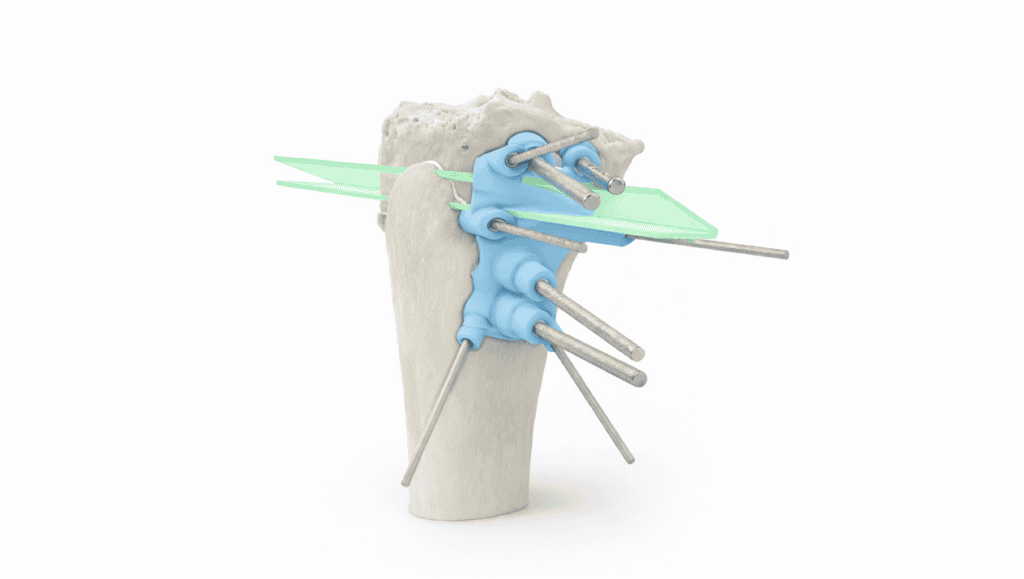
Anterior Closing Wedge High Tibial Osteotomy Surgical Guides
Anterior Closing Wedge High Tibial Osteotomy Surgical Guides
Patient Diagnosis:
The patient was diagnosed with an 18 degree posterior slope of their proximal tibia which the surgeon hoped to reduce to 5 degrees.
Planned Procedure/Approach:
Initially, the surgeon intended for a simpler supratubercle approach to spare the patella tendon and forego any risk to the tibial tuberosity. However, during planning it became clear this would not leave enough bone proximally for the plate to fix securely. A trans-tubercle approach was opted for instead.
What Insight Surgery provided:
- Patient specific 3D printed anatomical model
- Surgical Guide 1 – For the tibial tuberosity, this cut in the coronal plane to release the patella tendon and completely preserve it given the location of the subsequent osteotomy planes.
- Surgical Guide 1 – Design for the second guide, for the anterior closing wedge, had to ensure the posterior apex of the wedge did not breach the posterior boundary of bone. A centimeter of bone was left to act as a hinge, with no fracture, allowing proper bone contact posteriorly to help promote better healing and prevent the development of arthritis in later life.
- Both Guides had pilot holes built in for setting up the plate fixation, calculated to configure correctly post cut
Outcome/Benefits:
- The procedure was successful with crucial successes in maintaining patella tendon integrity, avoiding any breach of the posterior boundary, and correct plate fixation alignment
- K- Wires were used to help fixate the guide and define the cutting planes of the osteotomy, guiding the blade for greater accuracy.